Table of Contents
- What Is Anxiety and Why Does It Matter for Adolescents?
- Common Signs of Anxiety in Teens
- Normal Stress vs Anxiety Disorder in Teens
- Why Anxiety Is Both Useful and Harmful for Adolescents
- How to Help a Teenager with Anxiety
- When to Seek Help for Teen Anxiety
- Frequently Asked Questions
Last Updated: October 6, 2026
What Is Anxiety and Why Does It Matter for Adolescents?
Adolescent anxiety is the body’s built-in alarm system: apprehension, tension, and physical arousal that fires when a person perceives threat, uncertainty, or something they value at stake.
Anxiety matters for adolescents because it sits at the intersection of brain development, social pressure, and identity formation. It is neither a character flaw nor a permanent condition, it is a signal, and the question is whether that signal is proportionate.
Anxiety as a Normal Stress Response
Anxiety is a normal stress response when it appears in proportion to a real challenge, fades once the challenge passes, and pushes a person toward preparation rather than paralysis. A teenager with butterflies before a test who then studies harder is experiencing anxiety doing its job.
The American Academy of Child and Adolescent Psychiatry’s anxiety resources for families describes this as the expected “fight, flight, or freeze” response, a system designed to mobilize attention and energy.
When Anxiety Becomes a Public Health Concern
Adolescent anxiety becomes a public health concern when it stops being situational and starts being persistent, when it interferes with school, sleep, friendships, or daily functioning, and when it goes untreated long enough to shape a young person’s trajectory. The U.S. Surgeon General’s Advisory on Social Media and Youth Mental Health has flagged adolescent mental health as a national priority, noting that anxiety and depression symptoms among young people have risen sharply over the past decade.
Common Signs of Anxiety in Teens
The signs of anxiety in teens show up across three channels at once: the body, the emotions, and behavior. Teens rarely announce “I’m anxious.” They show it.
Physical, Emotional, and Behavioral Symptoms
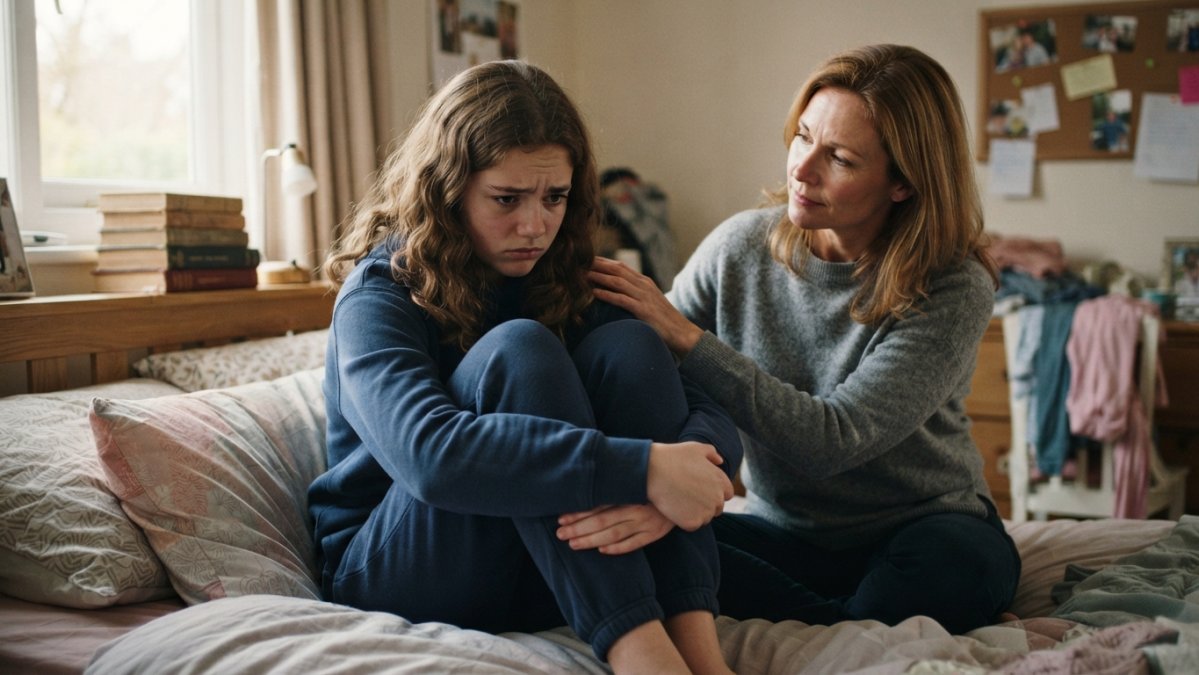
Physical symptoms include headaches, stomachaches, racing heart, sweating, fatigue, and trouble falling asleep. Emotional symptoms look like irritability, dread, restlessness, or low-grade sadness. Behavioral changes are often the loudest signal: dropping activities they loved, avoiding school or social events, snapping at family, or retreating to a screen for hours.
Here is the pattern most parents miss: avoidance is not laziness, it is relief-seeking. Every time a teen skips the party or the presentation, the anxiety drops, and the brain learns that avoidance works.
Treating avoidance as defiance and punishing it usually backfires. The teen learns to hide the anxiety rather than bring it to you, which delays the intervention that actually helps.
How Anxiety Affects Daily Functioning
Daily functioning is where anxiety leaves its fingerprints. Academic performance slips because attention gets consumed by worry, peer relationships thin out as social anxiety drives withdrawal, and sleep degrades, which worsens the anxiety, which worsens the sleep.
| Area of Life | What Anxiety Looks Like | Downstream Effect |
|---|---|---|
| School | Avoidance, perfectionism, test panic | Falling grades, missed assignments |
| Social | Withdrawal, fear of judgment | Shrinking peer network |
| Sleep | Racing thoughts at bedtime | Fatigue, irritability, worse focus |
| Family | Irritability, secrecy, conflict | Erosion of trust and support |
| Physical health | Stomachaches, headaches, tension | Frequent school absences |
Normal Stress vs Anxiety Disorder in Teens
Normal stress and an anxiety disorder differ along five dimensions: persistence, intensity, avoidance, distress, and interference. A teen with normal stress feels worried but still functions; a teen with an anxiety disorder feels consumed and stops functioning in at least one important area.
A Non-Diagnostic Framework: Five Questions to Ask
This framework is not a diagnostic tool, it organizes what you are observing so you can describe it clearly to a clinician.
- Persistence. Has the worry lasted weeks or months rather than hours or days after the stressor passed? Normal stress fades when the event is over; an anxiety disorder outlasts it.
- Intensity. Is the worry proportionate, or does it feel uncontrollable? A teen nervous about a presentation differs from one who rehearses catastrophic outcomes for days.
- Avoidance. Is the teen sidestepping the feared situation, skipping class, declining invitations, refusing to drive, with relief that reinforces itself? Avoidance is one of the clearest signals that anxiety has crossed from uncomfortable to impairing.
- Distress. Is the teen suffering visibly, irritability, tearfulness, physical complaints, sleep loss, even when the situation is not objectively threatening?
- Interference. Is at least one major life domain, school, friendships, sleep, family, health, measurably worse than before?
If the answer to most of these is yes, that is a signal to seek a professional assessment, not a reason to panic.
What the Distinction Looks Like in Practice
| Dimension | Normal Developmental Stress | Clinically Significant Anxiety |
|---|---|---|
| Persistence | Fades within days of the stressor | Persists for weeks or months |
| Intensity | Matches the situation | Feels uncontrollable, out of proportion |
| Avoidance | Minimal; teen still engages | Central; teen organizes life around escape |
| Distress | Manageable, intermittent | Constant, visible, disruptive |
| Interference | Little to none | At least one major domain impaired |
| Response to support | Improves with reassurance and rest | Does not improve with reassurance alone |
What This Is Not
This framework cannot tell you whether your teen meets criteria for a specific anxiety disorder. Only a qualified clinician can, through a structured assessment that considers duration, impairment, developmental stage, and other possible explanations, including medical conditions, trauma, and co-occurring depression or ADHD.
What the framework can do is help you describe what you are seeing in concrete terms: how long, how intense, how much avoidance, how much distress, and what it costs, exactly what a clinician needs to move quickly.
Why the Distinction Matters
Labeling normal developmental stress as a disorder can pathologize a teenager who simply needs rest, reassurance, and time. The National Institute of Mental Health’s overview of anxiety disorders notes that anxiety disorders are among the most common mental health conditions in the United States and are highly treatable with appropriate care, which is why getting the distinction right, early, matters.
The single most useful question is not ‘is my teen anxious?’ It is ‘is the anxiety costing them something they used to be able to do, and has it been doing so for weeks rather than days?’
Why Anxiety Is Both Useful and Harmful for Adolescents
Anxiety is useful when it sharpens preparation and harmful when it hijacks the same system. The difference is not the presence of anxiety but whether it is proportionate, brief, and action-oriented.
The Adaptive Side: Why Anxiety Earns Its Place
Anxiety is not a design flaw. It is an evolutionary alert system that mobilizes attention, energy, and memory around something that matters. In adolescents, it does real developmental work:
- Motivation and preparation. A teen who feels a knot in the stomach before a final exam studies more, not less. The discomfort is the cue to act.
- Risk calibration. Mild anxiety keeps a new driver checking mirrors and a new employee rereading an email before hitting send, the brake that prevents careless decisions.
- Social learning. Worry about how a comment landed drives a teenager to apologize, repair, and read a room more accurately over time.
When anxiety is tied to a real, resolvable challenge and fades once the challenge passes, it is functioning as intended. The goal is not to eliminate it but to keep it proportionate.
The Harmful Side: When the Same System Turns Against a Teen
Harmful anxiety uses the same physical machinery, racing heart, shallow breathing, muscle tension, intrusive thoughts, but points it at threats that cannot be resolved by action: fear of being judged, of failing permanently, of not being enough. Because no action fully discharges the alarm, the body stays activated, and the teen learns to escape rather than cope.
Three mechanisms explain why adolescence is a particularly vulnerable window:
- Asynchronous brain development. The limbic system, which generates emotional and threat responses, matures earlier than the prefrontal cortex, which regulates them, a strong accelerator with a brake still being built.
- Social reorientation. Peer approval becomes neurologically rewarding in a way it was not in childhood, so social threat registers as survival-level, which is why a group chat slight can feel catastrophic.
- Compounding stressors. Academic pressure, family expectations, part-time work, caregiving roles, and a digital environment that never turns off stack on top of one another. A system built for short bursts of threat now runs continuously.
The Cost When Anxiety Goes Unaddressed
Untreated anxiety does not stay contained. It shapes trajectories:
- Academic. Avoidance and perfectionism erode grades, which narrows post-secondary options.
- Social. Withdrawal shrinks the peer network that adolescents rely on for support and identity.
- Long-term. Anxiety in adolescence is a well-established risk factor for anxiety and depression in adulthood, which is why early intervention matters more than waiting for a crisis.
Equity and Context: Anxiety Is Not Distributed Evenly
Anxiety does not land on every adolescent the same way, and neither does the support available to manage it. Teens navigating unstable housing, food insecurity, discrimination, immigration stress, disability, or a lack of culturally responsive providers carry a heavier load with fewer buffers.
This is why the question ‘why does anxiety matter for adolescents’ has two answers. It matters because anxiety is a normal, useful signal that can go wrong, and because the consequences of it going wrong are not shared equally, which makes accessible, early, culturally informed support a public health issue, not just a family one.
Useful anxiety points a teen toward action they can take. Harmful anxiety points them toward threats they cannot resolve by action. The first builds competence. The second builds avoidance, and avoidance is what turns a rough season into a lasting pattern.
How to Help a Teenager with Anxiety
How to help a teenager with anxiety starts with validation, not correction. The instinct to say “you’re fine, don’t worry” is well-meaning and counterproductive. It teaches the teen that their experience is wrong.
Coping Strategies for Teens and Families
Coping strategies work best when specific and practiced before the anxiety peaks. What we recommend to families:
- Name it out loud. “That sounds like anxiety” gives the feeling a boundary. It stops being the whole self.
- Slow the body first. Four-second inhale, six-second exhale, repeated for two minutes. The body calms before the mind follows.
- Break the avoidance loop. Agree on one small step toward the feared situation, not the whole leap.
- Protect sleep like a treatment. Consistent bedtime, no screens for the last hour, no caffeine after noon.
- Set a worry window. Fifteen minutes a day to write down worries, then close the notebook.
- Keep the door open. Teens disclose to people who listen without immediately fixing.
When your teen brings you a worry, resist the urge to solve it in the first thirty seconds. Ask “do you want help thinking it through, or do you just want me to hear it?” Most of the time, they want the second one. That answer keeps them talking to you next week.
When to Seek Help for Teen Anxiety
Seek professional help for teen anxiety when symptoms persist for weeks, interfere with school, sleep, or relationships, or when a teen expresses hopelessness or self-harm. Those are not signs of weakness. They are signs that the system needs more support than a family can provide alone.
A Step-by-Step Route to Professional Support
Getting help is a process, not a single decision. The route we walk families through:
- Start with your primary care provider. Rule out medical causes and get a baseline.
- Request a clinical assessment. A qualified professional evaluates intensity, duration, and impairment.
- Clarify the goal. Symptom relief, skill-building, school functioning, or all three.
- Choose the level of care. Outpatient therapy, psychiatric evaluation, or a combination.
- Set a review point. Reassess in four to six weeks. Adjust if nothing is changing.
Treatment often combines psychotherapy, particularly cognitive behavioral therapy, with family support and, in some cases, medication. Early intervention consistently produces better outcomes than waiting for a crisis.
If you are unsure whether your teen needs care, a brief conversation with a professional can settle the question.
Anxiety in adolescents is not a flaw to correct. Salado Creek Mental Health provides patient-centered psychiatric care with personalized treatment planning, a team that listens before it labels, and a complimentary phone consultation to start.
Frequently Asked Questions
What is anxiety in adolescents?
Anxiety is a feeling of worry, nervousness, or fear that can be mild or intense. In adolescents, it often shows up as persistent worry about school, friendships, or the future. While some anxiety is a normal part of growing up, it becomes a concern when it interferes with daily life. Physical symptoms like headaches or stomachaches are common, along with avoidance of social or academic situations. If anxiety lasts for weeks or months and affects functioning, it may be an anxiety disorder that benefits from professional support.
How is normal stress different from an anxiety disorder in teens?
Normal stress is usually tied to a specific event, like an exam or a disagreement with a friend, and it fades once the situation resolves. An anxiety disorder involves excessive fear or persistent worry that lasts for weeks or months, even when there is no immediate threat. Teens with an anxiety disorder may avoid school, social activities, or new experiences, and the anxiety causes significant distress or impairment in daily functioning. A clinical assessment by a mental health professional can help distinguish between typical developmental stress and a diagnosable condition.
What are common signs of anxiety in adolescents?
Signs of anxiety in teens can be physical, emotional, or behavioral. Physical symptoms include headaches, stomachaches, fatigue, and trouble sleeping. Emotional signs include excessive fear, irritability, restlessness, and persistent worry. Behavioral changes might involve avoiding social events, declining academic performance, or withdrawing from family activities. Some teens also experience panic symptoms, such as a racing heart or shortness of breath. If these signs persist and interfere with daily life, consider reaching out to a healthcare provider for guidance.
When should an adolescent get professional help for anxiety?
Professional help is recommended when anxiety begins to interfere with a teen’s daily functioning, such as missing school, avoiding friends, or struggling to complete routine tasks. Other indicators include persistent worry that lasts for months, panic attacks, or thoughts of self-harm. Early intervention can make a significant difference. A good first step is to talk with a primary care provider, who can refer you to a mental health specialist. In some cases, cognitive behavioral therapy, medication, or a combination of both may be recommended based on a clinical assessment.